
Battery Maintainer Vs Battery Charger Difference
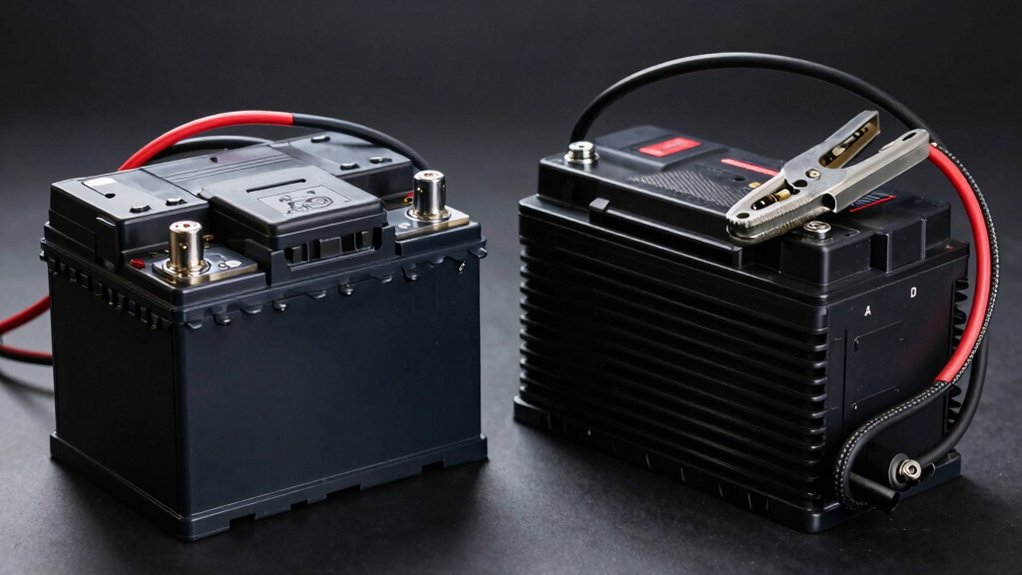
You need a maintainer when you want a charger to keep a battery healthy long-term. A charger delivers high current (typically 10–15 A) to restore a depleted battery; a maintainer supplies low, temperature-compensated float current (2–4 A or less) and holds the battery at safe float voltage indefinitely without overcharging.
Maintainers monitor voltage and adjust for cold temperatures and chemistry limits (AGM/gel/lithium). Chargers run shorter, supervised cycles; they keep going to learn specific voltages and limits.
Quick Overview
- A battery charger delivers higher current (typically 10–15 A) to restore a depleted battery quickly. A maintainer supplies low current (2–4 A) for long-term upkeep.
- Chargers run in timed or fixed modes and need supervision; maintainers operate automatically and can stay connected indefinitely.
- Maintainers use a controlled float voltage (around 13.2–13.6 V for lead‑acid) with temperature compensation to prevent overcharge and sulfation.
- Chargers use bulk and absorption stages (14.4–14.8 V for lead‑acid) to rapidly replenish charge, but they risk gassing if left too long.
- Match device settings to battery chemistry: AGM, gel, and lithium require specific voltages, currents, and temperature limits for safe charging and maintenance.
Charge/Float Current Comparison
How quickly do you need a battery topped up? You choose between rapid charge comparison and sustained float behavior. Chargers supply 10–15 A to restore depleted batteries in hours; they risk boil-out if run too long and need monitoring.
Maintainers use 2–4 A with microprocessor control, transitioning bulk to absorption to float automatically and allowing indefinite connection. Float holds 13.2 VDC, supplying only the current needed to offset self-discharge without gassing. Match voltage and chemistry to avoid damage: AGM needs specific profiles.
Use chargers for deeply discharged cells. Use maintainers for long-term preservation. The table below summarizes key current and control differences for direct operational decisions.
| Parameter | Charger vs Maintainer |
|---|---|
| Peak current | 10–15 A vs 2–4 A |
| Mode switching | Limited vs automatic |
| Float voltage | N/A vs 13.2 V |
| Continuous use | Short-term; supervised vs indefinite; unattended |
Cold-Weather Float Limits
Ever wondered how low temperatures affect a maintainer’s float voltage and battery health? In cold weather, you must adjust expectations: reduced chemical activity raises required float voltage and increases self-discharge sensitivity. Maintain correct float termination to avoid undercharging or thermal stress.
- Setpoint adjustment: increase float voltage per cell by ~3–5 mV/°C below 25°C to compensate for lower temperature.
- Monitoring: use a smart maintainer with temperature compensation and precise float termination to prevent chronic undercharge.
- Safety margin: avoid excessive compensation that raises gassing; limit adjustment to manufacturer specs and stop when the battery approaches full charge.
You’ll preserve capacity and prevent sulfation only by matching float termination to ambient cold weather conditions.
Battery Chemistry-Specific Limits
You need to respect chemistry-specific limits when choosing a maintainer or charger because each battery type has distinct voltage and temperature cutoffs. Set lead-acid units to their float/absorption voltages. Use AGM-specific float setpoints, and avoid overvoltage on gel cells which are particularly voltage-sensitive.
For lithium-ion and NiMH, enforce strict charge cutoffs and temperature constraints respectively to prevent damage and ensure safe long-term maintenance.
Lead-Acid Voltage Limits
When you work with lead-acid batteries, respect their specific voltage limits: A fully charged 12-V lead-acid battery measures about 12.6–12.8 V at rest and 14.4–14.8 V under a charging (absorption) stage. Float/maintenance voltages sit near 13.2–13.6 V to prevent overcharge. Exceeding these ranges risks gassing, water loss, and plate damage. Allowing resting voltage to drop below ~12.0 V (roughly 50% state of charge) accelerates sulfation and capacity loss.
You should design charging and maintaining systems around documented lead acid limits and defined voltage thresholds. Use chargers with adjustable absorption and float stages, confirm float holds around 13.3 V, and avoid sustained voltages above 14.8 V. Monitor resting voltage to detect chronic undercharge and prevent irreversible degradation.
Lithium-Ion Charge Cutoffs
Lead-acid and lithium-ion batteries require different voltage handling; therefore, apply chemistry-specific cutoffs rather than lead-acid norms. You must respect lithium-ion cutoffs: typical full-charge termination is 4.20V per cell (±0.02V) and end-of-discharge is around 2.5–3.0V per cell depending on chemistry. Configure chargers and maintainers to stop bulk charging at the correct voltage and transition to an appropriate reduced current state or disconnect.
Verify float current compatibility. Most lithium chemistries cannot tolerate continuous float at lead-acid float voltages; only purpose-built lithium maintainers with controlled microamp to low milliamp top-off are safe. Use BMS-aware chargers or units with precise voltage regulation, current limits, and timed cutoffs to avoid overcharge, thermal runaway, or capacity loss.
NiMH Temperature Constraints
Curious how temperature affects NiMH charging and storage? You must monitor NiMH temperature closely: optimal charge occurs between 10°C and 40°C. Storage is recommended near 15–25°C. Charging below 0°C risks plating and capacity loss; charging above 45°C accelerates degradation and thermal runaway.
Charge algorithms rely on dV/dt and temperature compensation. A smart charger reduces current or suspends charge if sensors detect unsafe temperature. During long-term maintenance, you’ll use a low-rate charge float-equivalent strategy tailored for NiMH, but true float charging isn’t ideal because NiMH self-discharge is high. Instead, intermittent top-ups with temperature-aware thresholds prevent overheat and cell reversal.
Always use equipment specifying NiMH profiles and temperature cutoffs to protect cycle life and safety.
AGM Float Voltage
How should you set float voltage for an AGM battery to maximize life while avoiding overcharge? You should target an AGM float of about 13.5–13.8 V for a 12 V battery, adjusted by temperature compensation. Configure voltage regulation to hold that range precisely; fluctuations above 14.2 V initiate gassing and corrosion, reducing cycle life.
Use a maintainer or charger with accurate voltage regulation and a low ripple output to prevent micro-overcharge. For long-term storage, verify cut-in/cut-out thresholds and ensure the device returns to float when the battery reaches full charge. Monitor periodically with a calibrated voltmeter or battery monitor. Proper AGM float settings minimize water loss, plate degradation, and self-discharge while preserving capacity.
Gel Battery Sensitivities
Why treat gel batteries differently than other lead-acid types? You must respect gel sensitivities: trapped electrolyte and tighter gas recombination make them intolerant of overvoltage and prolonged high float. Set float limits precisely lower than flooded or AGM cells to avoid electrolyte drying and plate damage.
Use chargers/maintainers with configurable float voltage and reliable voltage regulation; don’t rely on generic trickle units that lack accurate cut-in/cut-out thresholds. Monitor temperature compensation because gel chemistry responds poorly to elevated charge potential. Apply conservative float limits and confirm via manufacturer specs for each gel model.
Charge Current Restrictions
When should you limit charge current? You limit current whenever battery chemistry or condition dictates: typically for gel, AGM, and older lead-acid cells or when battery temperature is elevated. Restricting amperage protects electrode plates, prevents gassing, and preserves battery health by avoiding plate shedding and electrolyte loss.
Follow manufacturer C-rate limits; many gel and AGM cells accept 0.1–0.3C for safe charging. Flooded lead-acid tolerates higher pulses only after hydration checks. For lithium chemistries, use charger profiles with strict current and voltage cutoffs.
Set maintenance frequency according to self-discharge rates and storage duration: more frequent float checks suit higher self-discharge batteries. In practice, choose a charger/maintainer that enforces these chemistry-specific limits and monitors voltage, temperature, and time to safeguard longevity.
Frequently Asked Questions
Can a Maintainer Damage My Car’s Electronics if Left Connected?
No, a proper maintainer won’t damage your car’s electronics if it matches charging compatibility and you use it correctly. You’ll want a smart maintainer with float/auto modes and correct voltage for your battery type; that prevents overvoltage and current spikes.
Ensure good quality leads, a verified ground, and follow manufacturer specs. Poorly designed or incompatible units can cause issues. Therefore, maintainer safety depends on correct selection and installation.
How Long Does a Maintainer Need to Prevent Sulfation Effectively?
You’ll need to keep a maintainer connected continuously or at regular intervals for months to prevent battery sulfation effectively.
Modern smart maintainers switch to float and resume charging as voltage drops; this preserves charge without harming electronics safety if the unit’s grounded and suited for your vehicle. Verify equipment suitability for battery type (AGM, lithium).
Check manufacturer specs and monitor intermittently to ensure proper long-term protection.
Are Maintainers Safe to Use on Motorcycles and Lawn Equipment?
Yes, you can safely use maintainers on motorcycles and lawn equipment if you check maintainer compatibility and follow safety considerations. Match voltage and battery chemistry; use a smart maintainer with float mode and auto-resume. Avoid connecting to a fully dead battery without an initial charger.
Ensure correct clamps/polarity and secure ventilation for lead-acid. Follow manufacturer instructions to prevent overcharge, overheating, or damage to AGM or lithium packs.
Do Maintainers Require Ventilation During Long-Term Use?
Yes, you should provide ventilation when using a maintainer long-term near batteries that can emit hydrogen. You’ll reduce short circuit risk from accumulated flammable gas; you will also lower overcharging concern by keeping ambient temperature stable.
Use the maintainer’s float mode. Position it in a well-ventilated area, avoid sealed compartments, and keep terminals clean and covered. Follow manufacturer guidelines and use units with automatic shutoff and safety certifications.
Can I Jump-Start a Battery With a Maintainer Connected?
Yes, you can jump-start a battery with a maintainer connected; however, disconnect the maintainer first if possible to ensure jump start safety and avoid backfeed into the maintainer’s electronics.
If you must leave it connected, use clamps on exposed battery terminals. Verify the maintainer is in float or off, and confirm electronics compatibility with jump-start procedures. Follow manufacturer instructions to prevent damage to the maintainer or vehicle electronics.
Conclusion
You’ll choose a maintainer when you need long-term, low-current float charging that preserves state of charge without stressing the battery. Pick a charger when you need higher current to restore capacity quickly.
Match settings to chemistry: lead-acid, AGM, gel, lithium, NiMH. Heed temperature-dependent float limits and cold-weather cutoffs to avoid sulfation, thermal runaway, or capacity loss.
Follow manufacturer voltage/current specs and safety limits to ensure safe, efficient, and long-lived battery operation.