Car Detailing Lighting for Paint Inspection
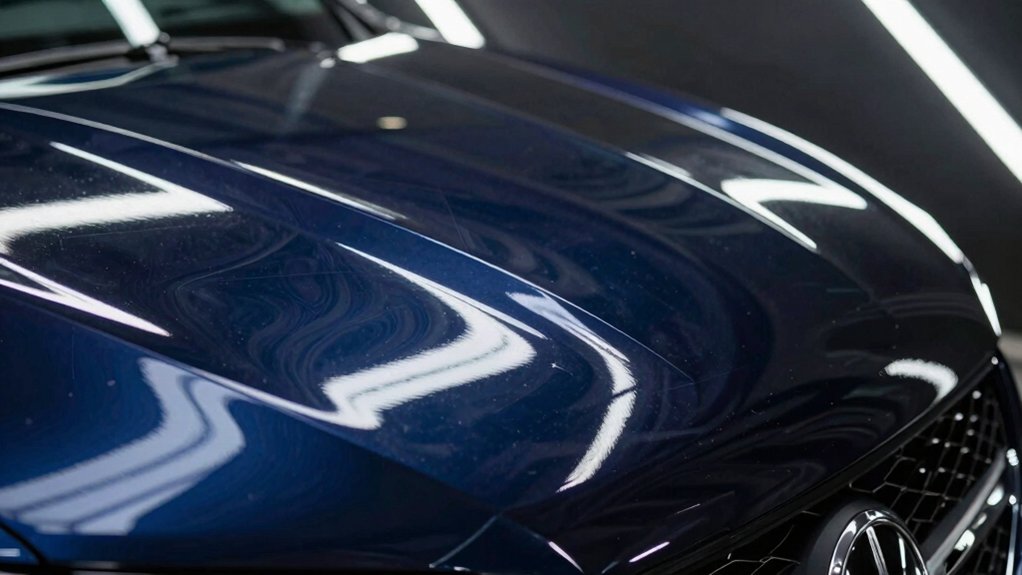
You should use controlled, high-CRI 5000–6500K lighting and maintain 2000–4000 lux at about 20–40 cm for reliable detection of swirls, haze and holograms. Raise to 3000–10,000 lux for larger defects at 1–2 m and above 3000 lux for micro‑finish work.
Measure fixtures with a color meter; match CRI/spectral output, avoid mixed sources, and replace bulbs in matched sets to prevent hue shifts. Follow documented setups and calibration steps to uncover why defects and color shifts appear.
Quick Overview
- Use consistent 5000–6500K lighting with high CRI to avoid hue shifts and reveal true paint color and defects.
- Inspect at distance: 3–6 ft for holograms; ~2 ft for scratches and haze; 3–4 in for micro swirls, adjusting lux accordingly.
- Target 2000–4000 lux for general inspection. Increase above 3000 lux for close-up detection without causing glare overload.
- Measure and document each fixture’s color temperature and spectral output. Replace bulbs in matched sets to prevent mixed-source artifacts.
- Control aiming and angles; minimize reflections and glare. Isolate the vehicle from ambient mixed lighting during inspections.
Lux Levels by Distance
How far should you stand to spot specific defects? You should use distance to target defect scale: 3–6 ft for large irregularities and holograms, ~2 ft for scratches, swirls and haze underfoot, and 3–4 in for micro defects on dark/soft finishes. Control glare management with directional LED sources at 5000–6500K and 100 fc (≈1,076 lm/m²) minimum.
| Distance | Defect focus | Recommended lux |
|---|---|---|
| 3–6 ft | Holograms, large defects | 3,000–10,000 |
| ~2 ft | Scratches, swirls, haze underfoot | 500–3,000 |
| 3–4 in | Micro swirls, fine finish | >3,000 |
Measure consistently. Use handheld LEDs for close work, and adjust aiming to minimize glare.
000K, 2000–4000 Lux
Why choose 2000–4000 lux for mid-range paint inspection? You use 2000–4000 lux when you need reliable defect detection without overdriving your workspace. This range balances visibility and comfort, exposing moderate swirls and surface texture while avoiding glare overload.
Don’t confuse its role with color temperature checks: subtopic irrelevance risks misapplication; avoid lighting disregard in procedure selection.
- Close inspection: handheld at 20–40 cm reveals micro-swirls under controlled angle.
- Panel sweep: tripods at 1–2 m show broader patterning without washout.
- Touch verification: directional fixtures confirm polish transitions and edge defects.
Measure with a calibrated lux meter. Document positions and standardize distance to ensure repeatable, technical results.
Color Temperature Consistency Check
You’ll start by confirming the nominal color temperature of your inspection lights because shifts in Kelvin directly alter perceived hue and can mask defects. Use a calibrated color meter to measure each fixture and document variance. Then standardize to a single target, typically 5000K–6500K, across the bay.
Eliminate mixed light sources or isolate the vehicle during inspection to prevent color casts that compromise judgment.
Understanding Color Temperature
When inspecting paint, start by confirming your light source consistently maintains the target color temperature: typically 5000K for general use or 6500K for lighter finishes. Fluctuations will change perceived hue and hide defects. You’ll measure and document color temperature consistency across fixtures using a calibrated spectroradiometer or high-quality colorimeter. Note deviations beyond ±100K.
Perform light source calibration at installation and after lamp changes or driver replacements. Record ambient and fixture readings and verify CRI remains stable. Additionally, log lamp age versus drift. If a unit exceeds tolerance, replace or re-calibrate immediately to preserve inspection integrity.
Maintain routine checks on handhelds, tripods, and overhead LEDs to ensure repeatable, objective comparisons during paint inspection and quality control.
Effects On Perceived Hue
Having confirmed color temperature stability across fixtures, check how small shifts influence perceived hue on different paints. You’ll measure hue shift by comparing target samples under nominal 5000K reference and each fixture; document delta values in a spectroradiometer. Focus on mid-tone neutrals, metallics, and pearlescents. Those finishes exaggerate tint variation.
Record CIE ΔE and correlated color temperature deviation for each lamp position. Then map perceptible thresholds: ΔE >1.0 is often visible in trained inspection. Control intensity to eliminate luminance-driven color bias. For pearlescent layers, rotate samples to observe angle-dependent hue shift under the same source. Use repeatable mounting and note ambient bleed.
Conclude by flagging fixtures whose tint variation exceeds acceptance criteria for accurate color assessment.
Consistent Lighting Setup
Why check color temperature consistency across your fixtures? You need repeatable conditions to detect subtle defects and confirm true paint tones. Use fixtures specified at a target temperature (typically 5000K) to maintain color consistency across the bay.
Verify matching CRI and spectral output so perceived hues don’t shift when you move from handheld to full-size lights. Implement controlled mounting locations and document lamp types to preserve fixture flexibility for different tasks while keeping baseline temperatures identical. Cycle new bulbs in matched sets; replace in groups to avoid mix-matching.
Limit mixed-source use (no halogen/CFL with LEDs) because tints and spectral gaps degrade inspection reliability. Maintain written procedures and log changes so every inspection runs under the same calibrated lighting conditions.
Measuring With Color Meter
You’ve already standardized fixtures and logged lamp types. Now verify those settings with a color meter to confirm all lights match the target color temperature. You’ll measure each luminaire at work height, record correlated color temperature (CCT) and CRI, and compare readings to your 5000–6500K target range.
Use repeatable positioning, shield the sensor from specular reflections, and average three readings per fixture. Flag deviations beyond ±150K for adjustment or replacement. Document results in a calibration log and tag fixtures that pass. Validate handheld and full-size units equally to maintain color consistency across inspection zones.
Finally, assess glare reduction by noting lamps with hot spots or high intensity that require diffusers or repositioning to protect visual accuracy.
Avoiding Mixed Light Sources
How will you ensure your inspection area doesn’t mix light sources that alter perceived paint color? You standardize fixtures to a single color temperature (preferably 5000K–6500K) and document placement; this aims for uniform illuminance across panels. Measure each lamp’s output and spectral distribution. Record deviations that introduce color bias.
Replace or reallocate fixtures whose lamp aging reduces correlated color temperature or lumen output below tolerance. Use only LED fixtures with consistent CRI and known aging curves. Avoid pairing LEDs with halogen or CFL units. Label circuits so technicians can’t switch in alternate lamps during inspection.
Verify uniformity with a lux meter and spectral check at scheduled intervals. Log corrective actions and component replacements for traceable consistency.
Calibration And Reference Light
Ever wonder whether the light you’re using today matches the reference standard you relied on yesterday? You should run a strict calibration workflow: use a calibrated spectrometer or colorimeter to measure color temperature and CRI of your reference illumination, documenting 5000K baseline for color accuracy or 6500K when emphasizing surface defects.
Verify intensity meets minimum 100 foot-candles at inspection plane and that correction lights exceed ambient. Record measurements, ambient conditions, and fixture IDs in a log. Recalibrate after lamp replacement, major drift, or every 6 months. Use consistent reference illumination across all inspection stations to avoid mixed-light errors.
Implement pass/fail thresholds for delta CCT and lux to ensure repeatable, objective paint inspections and reliable color matching.
Frequently Asked Questions
Which Light Fixtures Minimize Glare on Glossy Finishes?
Use directional LED fixtures with diffusers and low-glare optics to minimize glare on glossy finishes. You’ll prefer Scangrip tripod or LDPI directional models with beam control; Banner WLB92 with anti-glare louvers; or G&G luminaires fitted with opal diffusers.
You’ll position lights at oblique angles, use polarizing filters when possible, and dim to required foot-candles. These methods provide glare reduction while preserving defect visibility and accurate color rendition.
How Often Should Inspection Bulbs Be Recalibrated?
You should recalibrate inspection bulbs every 6–12 months as a baseline. Increase frequency to quarterly if you run high-hour LEDs or operate in variable ambient light.
Establish a recalibration cadence tied to hours used, lamp output drift, and CRI checks. Include inspection lamp maintenance tasks: record lumen/temperature measurements, clean optics, verify color temperature and flux, and log results.
Adjust cadence after failures or process audits to maintain Class A standards.
Can Portable Carts Withstand Outdoor Use?
Yes, portable carts can withstand outdoor use when they’re specified for outdoor durability. You’ll want carts with weatherproof housings, sealed connectors, corrosion-resistant frames, and IP-rated fixtures.
Verify temperature and UV ratings; cable strain relief; and stable mounting for wind. Choose models with sealed battery compartments and waterproof switches or use protective covers.
Follow manufacturer maintenance schedules, inspect seals regularly, and avoid extended exposure beyond rated conditions to ensure longevity.
What CRI Is Recommended for Color-Matching Interiors?
Use CRI 90+ for accurate color-matching interiors; CRI specifications for color matching interiors should target 95 when possible. You’ll follow interior color consistency lighting guidelines by selecting high-CRI LEDs (90–98) at 5000K to reveal true hues without tint bias.
You’ll measure and validate under controlled illuminance. Keep lighting uniform, minimize glare, and use dimmable fixtures to match samples reliably across seats, trim, and panels for repeatable results.
Are Dimmable Fixtures Safe for Battery Operation?
Yes, dimmable fixtures can be safe for battery operation if you follow specifications. You’ll ensure dimmed operation matches driver and battery capabilities. Verify inrush current, thermal limits, and compatible dimming protocol (PWM/0–10V).
You’ll use proper surge protection, monitor voltage sag, and include battery management and cooling. Test runtime under load, confirm luminous output at lower charge, and adhere to manufacturer guidance for battery powered safety to prevent failures.
Conclusion
You’ll use consistent, calibrated lighting and measured lux levels to reliably inspect paint. Keep illuminance in the 2000–4000 lux range at working distance. Verify color temperature with a meter, and avoid mixed light sources that shift perceived hue.
Check white balance and reference a certified light source before each session. Document settings. This methodical approach removes ambiguity; it ensures repeatable results and helps you detect defects and color mismatches with technical confidence.