Foam Prewash Vs Contact Wash
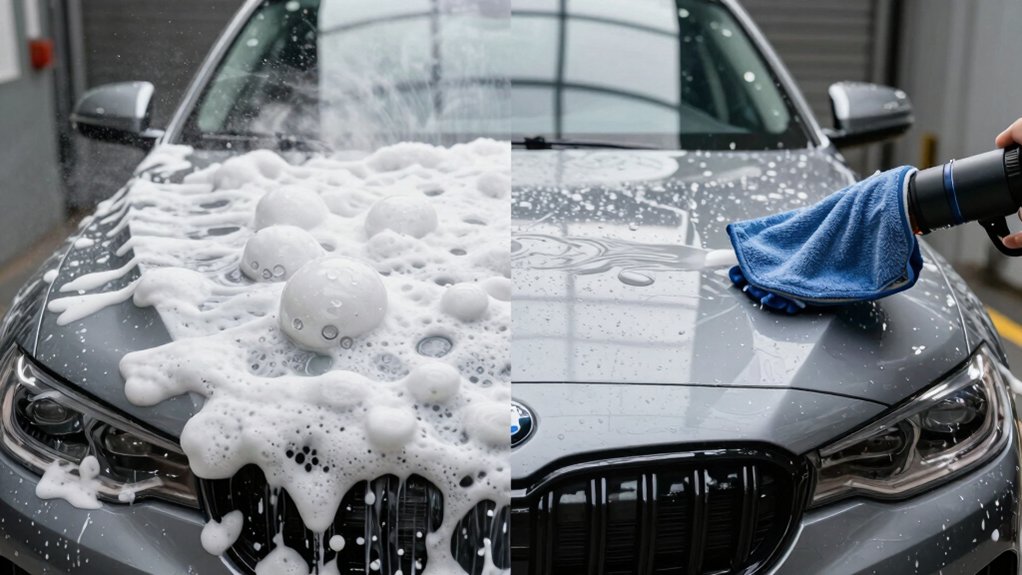
You’ll pick foam prewash when you want thick, clinging detergent to lift traffic film and maximize dwell time for gentle chemical action. It’s best for broad coverage and delicate finishes.
Use contact wash when you need targeted shear and mechanical action to strip bonded grime or heavy deposits. Control foam with concentration, nozzle angle, and pressure; keep rinses lukewarm to protect coatings. Keep going and you’ll find specific settings and trade-offs for each method.
Quick Overview
- Foam prewash applies thick foam to safely loosen and lift surface dirt with long dwell before rinsing or contact cleaning.
- Contact wash physically scrubs or pressures contaminants; this provides deeper removal but increases risk to sensitive coatings.
- Use foam prewash for light-to-moderate soils to reduce product use and mechanical abrasion during the follow-up wash.
- Choose contact wash for heavy, bonded grime or oily films. Use higher PSI and appropriate alkaline chemistry cautiously.
- Balance foam thickness, nozzle angle, and pressure to maximize dwell from prewash while minimizing coating risk during contact cleaning.
Foam Thickness vs Dwell Time
How long should foam stay on your paint? You want foam thickness that gives a practical dwell duration: thick foam clings 2–5+ minutes, lifting and breaking contamination before sheeting. Thin foam gives shorter dwell and stretches product. Adjust concentration, water quality, and application to control cling and lubrication.
| Variant | Typical Dwell | Best Use |
|---|---|---|
| Thick foam | 2–5+ min | Heavy or vertical grime |
| Thin foam | Maintenance, budget washes | |
| Medium foam | ~1–3 min | Routine cleaning, balanced cost |
Use soft water and higher mix for dense foam. Choose thin mixes for light dirt or limited product. Monitor temperature and avoid over-layering to prevent waste.
Rinse Water Temperature Limits
Wondering what temperature your rinse water should be? You’ll need to respect temperature constraints to protect coatings, avoid thermal shock, and preserve cleaning chemistry. Use lukewarm water for most rinses; extremes reduce effectiveness and risk surface damage. Hot water can strip protective layers and accelerate drying spots. Cold water limits detergent action and slows soil removal. Balance is key: aim for temperatures that maintain foam and pre-wash performance without stressing paint or seals.
Avoid >50°C on painted panels to prevent coating softening. Don’t use
Nozzle Pressure and Angle
You’ll want to set nozzle pressure to balance coverage and surface shear stress: higher pressure improves cleaning but raises the risk to paint. Use fan nozzles at shallow angles for wide, even foam retention time. Use steeper angles where you need more shear to shift bonded grime.
Adjust pressure and angle together so foam retention maximizes chemical dwell without forcing abrasive contact.
Optimal Spray Pressure
When setting spray pressure and angle for foam or pre-wash, aim for a firm but controlled output: enough force to dislodge grime without blasting coatings or driving contaminants into crevices. You’ll target an optimal spray pressure that balances cleaning power and substrate safety; typically moderate psi for snow foam, higher for alkaline pre-wash on heavy traffic film.
Adjust pressure to maintain consistent foam thickness from lance or cannon. Too low and foam thins; too high and dwell is shortened by breakup. Hold the nozzle perpendicular at a safe standoff, using short bursts to test removal efficiency. Monitor results and reduce pressure if you see coating lift, paint marring, or if grit is driven into seams.
Record settings for repeatable, safe performance.
Fan Nozzle Angles
How should you set fan nozzle angle and pressure to balance cleaning power with paint safety? You’ll start by selecting a foam nozzle that produces an even sheet; spray symmetry reduces hot spots that can etch or streak coatings.
Use lower pressure (800–1200 psi equivalent from a pressure washer) for foam prewash to avoid lifting paint edges while keeping chemical contact. Hold the wand 12–24 inches from the surface and sweep at a consistent speed and angle, typically 25–40 degrees from perpendicular, to maintain coverage without concentrating force.
For stubborn grime, reduce angle toward perpendicular and increase pass count rather than spike pressure. Check foam pattern regularly and adjust nozzle or pressure to restore uniform spray symmetry for safe, effective cleaning.
Impact On Coverage
Nozzle-angle control and pressure settings directly determine foam coverage and dwell consistency. You’ll want to balance wider fan angles with moderate pressure to maximize even spread without sacrificing cleaning contact.
You’ll adjust spray uniformity by tuning pressure: higher pressure narrows trajectory and increases impact, reducing dwell but improving penetration. Lower pressure broadens pattern but risks coverage gaps if angle or overlap’s off. Aim for overlapping passes at consistent speed to eliminate gaps while avoiding excessive force that strips foam.
Use narrower angles for recessed areas and wider angles on flats. Monitor foam thickness visually and tweak nozzle pressure in small increments. Consistent technique and calibrated nozzles keep coverage predictable and efficient across panels.
Surface Shear Stress
Why does spray angle and pressure matter for surface shear stress? You adjust nozzle pressure and angle to control shear rate at the paint-film interface. Higher pressure increases fluid velocity, raising shear rate and helping overcome surface tension bonds that hold dirt.
A shallow angle reduces normal impact and increases tangential force, promoting sliding removal with less risk of embedding particles. Steeper angles give stronger normal stress, useful for stubborn grime but can force contaminants into pores.
Balance pressure to strip traffic film without assaulting coatings; lower pressures with optimized angle can exploit shear rather than impact. You monitor foam or pre-wash behavior: thicker snow foam lowers effective shear by raising surface tension and dwell, so adjust nozzle settings accordingly.
Foam Retention Time
You just learned how spray angle and pressure control surface shear stress. Now apply that thinking to foam retention time because the way you set nozzle pressure and angle directly changes how long foam clings and how it behaves on the paint.
Lower nozzle pressure and a wider spray angle create gentler impact, increasing foam duration and promoting uniform dwell stability across panels. Higher pressure or narrow angle drives shear, reducing retention and risking premature runoff that shortens chemical action.
Aim for settings that balance coverage with minimal mechanical stripping of the foam blanket so snow foam or pre-wash stays long enough to solubilize contaminants. Monitor runoff patterns and adjust pressure/angle in real time to optimize foam duration and reliable dwell stability without excess overspray.
Equipment Wear Rates
Understanding equipment wear helps you set nozzle pressure and spray angle to balance performance and longevity. You’ll monitor nozzle wear because high pressures and acute angles increase mechanical erosion and cavitation, which shortens pump life and reduces equipment durability.
Set pressure to the minimum that achieves effective pre-wash or foam distribution; that lowers stress on fittings and seals. Use wider spray angles for foaming to reduce point-loading on surfaces and nozzles; reserve narrower angles for targeted pre-wash on stubborn grime.
Inspect nozzle orifices regularly for shape changes and replace them when flow patterns degrade. Log operating hours, pressures, and angle settings to correlate practices with wear rates. Then adjust protocols to optimize cleaning effectiveness while extending service intervals.
Frequently Asked Questions
Is Snow Foam Safe on Ceramic-Coated Paint?
Yes, snow foam is safe on ceramic-coated paint when used correctly. You’ll respect ceramic coating compatibility by choosing pH-neutral foams and proper application techniques (foam lance/cannon, correct dilution, dwell time).
You’ll avoid aggressive alkalines and excessive scrubbing to preserve hydrophobic properties. You’ll monitor results and practice continuous improvement by adjusting product choice and technique after each wash to maintain coating longevity and finish integrity.
Can I Use Pre-Wash on a Dusty, Dry Car?
Yes, pre wash viability on dusty surfaces is high if you use the right product and technique. You’ll apply an alkaline or targeted pre-wash spray to a cold, dry vehicle. Letting it dwell will loosen bonded dust and traffic film.
Don’t scrub dry; let the chemistry lift contaminants. Then rinse thoroughly before contact washing. For heavy buildup, follow with a second pre-wash round to ensure safe, scratch-free cleaning.
How Do Wheels and Wheel Arches Differ in Treatment?
Wheels treatment demands stronger, targeted chemistry and agitation. You’ll use an alkaline or citrus pre-wash, wheel cleaner, and brushes to dissolve brake dust and oily grime.
Arches treatment calls for wider coverage and dwell time. You’ll apply pre-wash thoroughly inside arches, let it break bonded salt and mud, then rinse and follow with a pressure rinse.
Both need rinse-first avoidance and correct dilution for paint and coating safety.
Will Pre-Wash Strip Existing Wax or Sealant?
Yes, a strong prewash can cause prewash wax or sealant stripping if it’s highly alkaline or used undiluted. You should use manufacturer-recommended dilutions and pH-safe formulas to avoid stripping.
Snow foam (pH-neutral) is gentler and preserves coatings, while concentrated alkaline pre-washes cut heavy grime but can reduce protection. Rinse thoroughly; test a small area and reapply wax or sealant after aggressive cleaning to restore protection.
Can I Apply Snow Foam in Cold Winter Conditions?
Yes, you can apply snow foam in cold weather, but you’ll need to manage conditions. Use warmed solution if possible and avoid frozen surfaces. Apply foam quickly to prevent freezing and keep foam application continuous. Work in shaded or sheltered areas and rinse before ice forms.
Use pH-neutral, low-freeze formulations and shorter dwell times. If temperatures are well below freezing, consider a heated bay or postpone to avoid residue and safety risks.
Conclusion
You’ll choose foam prewash when you need longer dwell, better cling on vertical surfaces, and lower immediate shear. It’s optimal for stubborn soils and when rinse temperature or water pressure is limited.
Use contact wash when you need rapid removal with high surface shear and uniform coverage at optimal spray pressures and fan angles. Balance foam retention, nozzle selection, and equipment wear to match soil type and cycle time. Minimize rework and maintenance.