How to Read a Tire Pressure Gauge
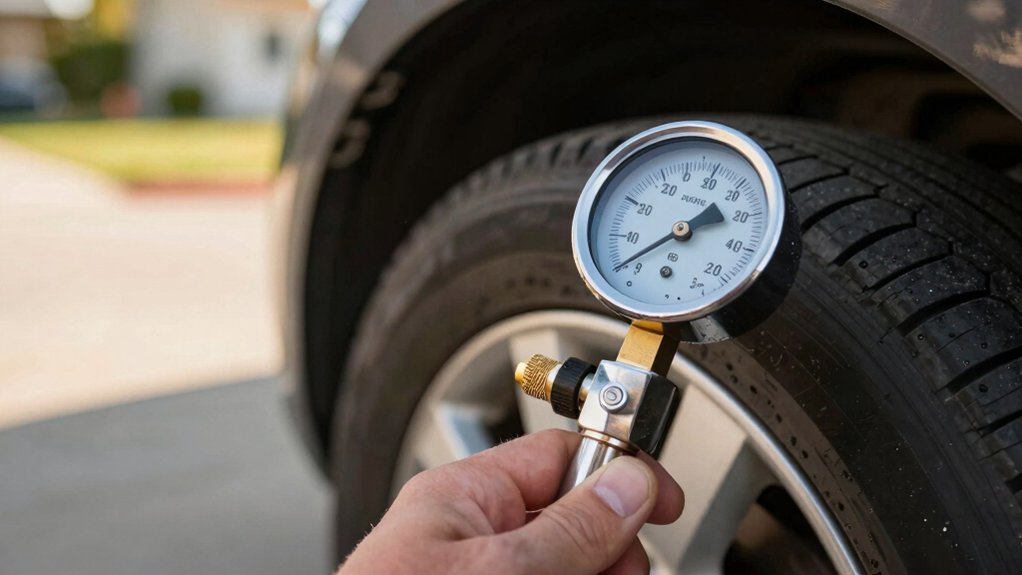
You’ll seat the gauge squarely on the valve stem, press firmly until the hiss stops, and hold steady to get the PSI reading. Use a stick, dial, or digital gauge and reseat the cap afterward.
Always measure when the tire is cold (three hours resting) and compare to the driver-side door-jamb cold-PSI targets, not the sidewall max. Don’t adjust from hot readings; account for approximately 1 PSI per 10°F change. Keep monthly checks — continue for detailed tips.
Quick Overview
- Use the vehicle’s driver-side door-jamb sticker for the correct cold-PSI target, not the tire sidewall maximum.
- Measure tire pressure when tires are cold (after 3+ hours rest) to match the manufacturer’s cold-PSI.
- Press the gauge squarely onto the valve stem. Listen for a brief hissing seal, then read the displayed PSI.
- Compare the measured PSI to the door-jamb target. Add or release air until pressures match front/rear specs.
- Recheck with the gauge after inflating. Reseat valve caps, and monitor monthly or after temperature changes.
Recommended PSI by Vehicle
Where should you set your tire pressure? You’ll follow manufacturer cold-PSI targets based on vehicle class to control tire wear and compensate for outside temperature effects. Check the door-jamb or manual, then adjust for load: add ~5 PSI for heavy towing, reduce slightly for off-road. Measure cold; heat raises PSI 3–5. Use these baseline ranges.
| Vehicle Class | Cold PSI Range |
|---|---|
| Compact car | 28–33 |
| Sedan/family | 30–35 |
| Performance car | 32–36 |
| Crossover SUV | 35–40 |
Match front/rear per spec; don’t use sidewall max as target. Monitor wear patterns and recheck pressure monthly or after notable outside temperature shifts to maintain even wear and handling.
Door Jamb PSI Label
Ever wondered where to find your vehicle’s correct cold-PSI? Look at the door jamb sticker on the driver’s side; it lists recommended pressures for specific tire placement (front, rear, spare). You’ll use those values as the target when you read any gauge.
Confirm tire placement (front/rear) matches the sticker before inflating. Note manufacturer-specified PSI for loaded vs. unloaded conditions. Use the door jamb value, not the tire sidewall maximum, for safety. Record the recommended PSI to compare with your gauge readings later.
Treat the door jamb label as the authoritative source. When you check pressure, align gauge readings to the listed cold-PSI for each tire placement. Adjust as needed, and recheck to verify accuracy.
Cold-Tire vs. Hot-Tire Readings
Cold-tire readings are taken after the vehicle has sat for at least three hours. They reflect the baseline PSI your tires should match to the door-jamb label.
Hot-tire readings occur after driving and show elevated pressure because heat expands the air; you’ll see higher PSI than cold measurements. You should measure cold for setting pressures. Check hot only to spot rapid pressure changes that could indicate safety or performance issues.
Cold-Tire Definition
Why check tire pressure before you drive? You need a true baseline: a cold tire reading. A cold tire is one that hasn’t been driven for at least three hours or has been driven less than a mile at low speed. You’ll get a consistent PSI unaffected by heat buildup.
Measure each tire with your selected gauge: stick, dial, or digital. Make sure the gauge seats firmly on the valve. Record the PSI and compare it to the manufacturer’s recommended cold pressure.
Don’t adjust based on a hot tire reading taken after driving; heat raises air pressure and gives a falsely high value. Use cold-tire measurements for inflation, troubleshooting, and routine maintenance for accurate, repeatable results.
Hot-Tire Definition
How does a hot tire differ from a cold one? A hot tire definition focuses on temperature-driven pressure rise after driving. When you check tires right after use, the rubber and air are warmer; so measured PSI will be higher than cold-tire values. You should understand this to avoid overinflation: use the manufacturer’s cold pressure spec, not the hot reading, unless the manual specifies otherwise.
For practical checks, wait at least three hours or measure before driving. If you must check hot, note that readings will reflect operational pressure, not baseline inflation. Keep records: compare hot readings against expected increases to detect slow leaks or abnormal heat buildup.
Knowing why pressures change helps you interpret readings correctly.
Why Pressures Change
Wondering why your tire pressure jumps after a drive? When you drive, friction and flexing heat the air inside the tire and raise pressure: often 2–6 PSI or more depending on speed, load, and ambient temperature. You’ll get a higher hot-tire reading than a cold one; that’s normal.
Check pressures cold for baseline accuracy because hot readings can mask slow leaks or an underinflated minor tire that still drives fine but risks uneven wear. Use that cold baseline to set pressures to the manufacturer spec. If you must measure hot, expect higher values and correct only a small amount. Always record whether readings were hot or cold so you can track trends and spot progressive pressure loss.
When To Measure
You’ll want to check tire pressure when the tires are cold whenever possible, because driving heats the air and raises pressure by a few PSI, which can mask leaks or underinflation. Measure after the vehicle has sat at least three hours or before initial morning use. That cold-tire baseline is the reference manufacturers give on the door placard and in the manual.
If you must measure hot tires, note increased readings and subtract roughly 2–4 PSI per tire as a corrective estimate; record conditions. For systematic maintenance, schedule measurement timing into your routine: monthly checks, before long trips, and after load changes. These topic ideas keep readings comparable and troubleshooting effective. Always reseat valve caps and log readings for trends.
Safety And Performance
Why does cold vs. hot tire pressure matter for safety and performance? You need consistent, accurate readings to maintain grip, braking distance, and even wear.
Cold-tire readings reflect baseline PSI; hot tires increase pressure as heat builds during driving, altering handling. If you measure when tires are hot and treat that as baseline, you risk underinflation once they cool. Conversely, compensating for hot readings without proper method leads to overinflation.
Focus measurement on cold tires. Don’t let insufficient focus on temperature produce misleading adjustments. Keep notes of manufacturer PSI and check pressures regularly to detect trends in leakage or wear.
Avoid unrelated topics during measurement: stay procedural. Valve cap off, gauge seated, read, replace cap.
Adjusting For Temperature
How should you adjust tire pressure for temperature changes? You’ll check pressures when tires are cold, as the vehicle is parked for at least three hours. This is because temperature effect alters PSI roughly 1 PSI per 10°F (5–6°C). Use the manufacturer’s cold PSI as your baseline.
If ambient temperature has risen after driving, wait for cooling or subtract the estimated PSI increase rather than adding air to a hot tire.
Perform gauge calibration checks periodically: test your stick, dial, or digital gauge against a known-good unit or at a service station. When inflating, add small amounts and recheck; use the gauge’s reading after temperature stabilization.
Document seasonal targets (cold-winter vs. warm-summer) and adjust per owner’s label, not the tire sidewall.
Frequently Asked Questions
Can I Use Any Gauge on Bikes and Cars Interchangeably?
Yes, but check gauge compatibility and valve type first. You can use most stick, digital, or dial gauges on bike and car valves; however, you’ll need the right chuck or adapter for Presta bike valves and some high-pressure road tires.
Using the proper tool preserves measurement accuracy. A poor seal or wrong adapter will give false PSI. Match ranges too: use a gauge rated for the vehicle’s pressure for reliable readings.
How Often Should I Replace a Digital Gauge’s Batteries?
You should replace a digital gauge’s batteries every 1–2 years or sooner if the digital battery life indicator shows low or readings become erratic. For heavy use, check every 6–12 months.
Always use the manufacturer-recommended cell to preserve gauge durability. Keep spare batteries and test the unit before trips; a weak battery can give false PSI. Replace immediately if the display dims, freezes, or the gauge fails to power on.
Do Altitude or Temperature Changes Affect PSI Readings?
Yes, altitude effects are minimal on tire PSI at a given tire volume, but temperature fluctuations matter a lot. You’ll see about 1 PSI change per 10°F (≈5.6°C) ambient shift as air contracts or expands.
If you drive to higher elevation, only barometric change affects absolute gauge reference slightly. Compensate mainly for temperature by checking pressures cold and adjusting to manufacturer PSI. Then recheck after notable temp shifts.
Can I Leave Tire Pressure Sensors in During Gauge Use?
Yes, you can leave tire pressure sensors in during gauge use. For gauge usage etiquette, don’t yank or hit the valve stem; press the gauge straight and firmly to form a tight seal so you won’t disturb the sensor.
Use short, steady contacts with stick, dial, or digital gauges. If your vehicle has TPMS sensors, avoid excessive force or long pry motions that could damage the sensor or valve core.
Are Tire Pressure Gauges Calibrated or Need Recalibration?
Yes, gauges need calibration and occasional recalibration to maintain gauge accuracy. You should check calibration frequency based on use: heavy shop use calls for quarterly checks; occasional personal use can be annual.
Verify against a certified master gauge or calibrator, and recalibrate or replace any unit showing drift beyond the manufacturer’s tolerance. Keep records of calibration, test at ambient temperature, and handle gauges carefully to preserve long-term accuracy.
Conclusion
Check your vehicle’s recommended PSI on the door jamb label and measure tire pressure when tires are cold. Use a calibrated gauge and press firmly to avoid leaks. Compare the reading to the recommended cold-tire value. If pressure’s low, add air; if high, release until it matches the label.
Remember that hot-tire readings run higher; don’t inflate based on them. Regularly check pressures, especially with big temperature changes, to maintain safety, fuel efficiency, and tire life.