Microfiber Gsm Meaning for Towels
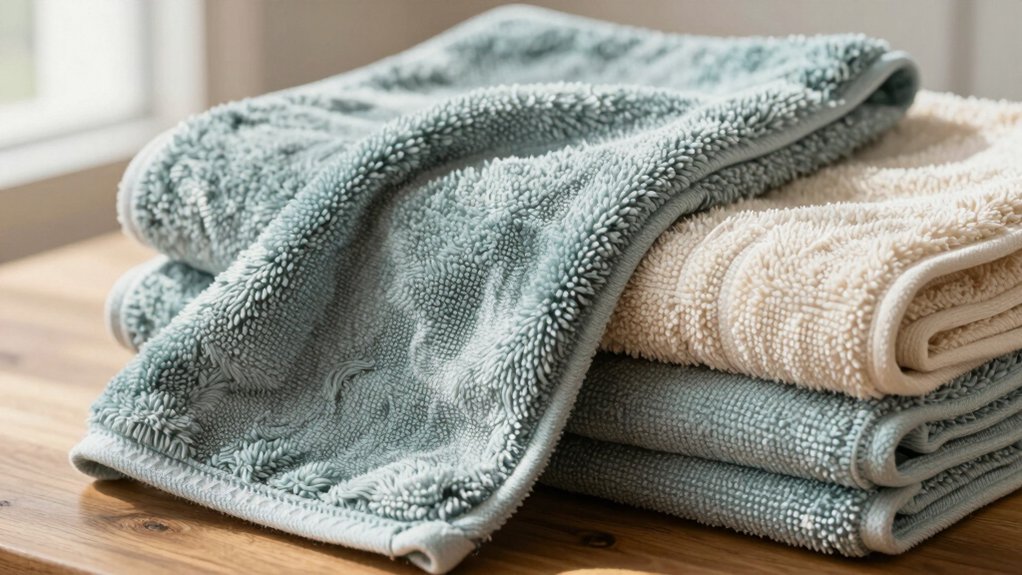
Microfiber GSM (grams per square meter) tells you a towel’s fabric weight, which directly predicts thickness, density, absorbency and dry time.
Lower GSM (200–300) suits light cleaning and quick-dry tasks; 300–400 offers balanced detailing and handling. 500–600 gives plush drying for delicate finishes, while 700–1100 targets professional, maximum water-holding performance.
Verify GSM by precise weighing per area and inspect pile loft. Follow recommended wash/dry limits to preserve capillary action: more specifics follow below.
Quick Overview
- GSM (grams per square metre) measures towel fabric weight and indicates thickness and fiber density. Higher GSM generally means greater liquid absorption but slower drying.
- 200–300 GSM suits lightweight, fast-dry cleaning tasks; 300–400 GSM is general-purpose detailing.
- 500–600 GSM is plush and best for gentle drying; 700–1100+ GSM gives maximum professional absorption.
- Verify GSM by precise weighing per area, inspect pile loft, and perform colorfast and abrasive safety checks before use.
GSM vs Thickness Chart
How dense is your towel, and how does that density affect performance? You’ll use gsm meanings to predict absorbency, pile loft, and handling: higher GSM equals thicker, denser microfiber with greater liquid uptake but slower drying. Refer to this concise thickness chart for quick orientation.
| GSM Category | Typical Use |
|---|---|
| 200–300 | Lightweight cleaning, fast-dry tasks |
| 300–400 | General-purpose detailing, balanced |
| 500–600 | Plush drying, delicate surfaces |
| 700–1100 | Professional drying, maximum absorption |
Empirical data show direct correlation between grams per square meter and fiber density. 1100 GSM holds substantial water while remaining manageable. Use measured GSM to select towels for task-specific performance; balance absorbency, drying time, and handling requirements.
Quick Towel GSM Checklist
Want a fast way to pick the right towel? Use this concise GSM checklist to match function to fabric properties. You’ll assess weight, pile behavior, and test results against application requirements. Check measured GSM against intended use: low for light-duty, medium for multi-use, high for drying or delicate surfaces. Include abrasive safety evaluation and colorfast testing before field use.
- Verify GSM with precise weighing and area conversion to confirm manufacturer claims.
- Inspect pile density and loft relative to target GSM range to predict absorbency and surface contact.
- Perform simple colorfast testing and abrasive safety checks on an inconspicuous area to prevent staining or surface damage.
Follow the checklist systematically to make evidence-based towel selections.
Care Instructions and Drying Limits
When caring for microfiber towels, follow temperature and chemistry limits to preserve GSM-related performance: wash at or below the manufacturer’s recommended temperature and use only compatible, low-residue detergents.
Never use fabric softeners or bleach, as they coat or damage fibers and reduce absorbency. Tumble dry on low or opt for line drying to minimize heat damage and preserve pile loft and lint-free efficacy.
Wash Temperature Limits
Curious about the safest wash temperature for your microfiber towels? You should use low to moderate wash temperature settings: 30–40°C (86–104°F) is optimal for most microfiber blends. That range preserves polymer structure, maintains fiber split, and limits thermal shrinkage or melting of synthetic filaments.
Higher temperatures (>60°C) can degrade polyester and polyamide components; they can reduce absorbency and increase lint production. If towels are heavily soiled, pre-soak or use mechanical agitation rather than elevated heat to sanitize. Always check manufacturer labels: some high-GSM, heat-stable constructions tolerate slightly higher temperatures, but that’s the exception.
Use cool rinses to remove residue and avoid high-heat drying that compounds thermal damage initiated during washing.
Recommended Detergents Only
Which detergents should you use: Choose mild, pH-neutral liquids formulated for synthetics and avoid bleach, fabric softeners, and high-alkaline powders that degrade microfiber performance. You should select recommended detergents that minimize ionic residues and maintain fiber repellency and capillary action.
Use measured doses to prevent excess surfactant deposition, which reduces absorbency relative to towel density and GSM. For machine washes, set a gentle agitation cycle and cold-to-warm water to optimize detergent efficacy without fibrillation. Rinse thoroughly; evidence shows two rinse cycles remove >95% of soluble residues in most formulations.
If you launder different GSM towels together, sort by towel density to ensure uniform mechanical stress and detergent distribution. Store laundered towels dry and uncompressed to preserve fiber loft and function.
Avoid Fabric Softeners
After choosing mild, pH-neutral detergents and optimizing wash cycles, you should never use fabric softeners or dryer sheets on microfiber towels. They deposit silicone- or oil-based coatings that impair capillary action and reduce absorbency. Studies show treated microfibers absorb significantly less liquid.
To avoid softener contamination, run a warm rinse cycle or add white vinegar (30–60 ml per load), which disperses residual surfactants without leaving fabric residue. Inspect towels under light for sheen or stiffness after washing; any change indicates coating. If you detect fabric residue, rewash at a higher temperature compatible with GSM and fiber blend, using no additives.
Consistent exclusion of softeners preserves microfiber loft, maximizes liquid uptake, and maintains lint-free performance for precision tasks.
Tumble Dry Low
How should you dry microfiber towels to preserve their structure and absorbency? Use tumble dry low settings to limit heat exposure that degrades microfibers and bonding agents. High temperatures can melt nylon/polyester blends, reduce loft, and decrease GSM-effective thickness. Controlled heat maintains fiber morphology and capillary action.
For fabric care, remove towels promptly at the end of the cycle to prevent static and compressive flattening. Avoid over-drying; target residual moisture around 1–3% to preserve absorbency. If your dryer lacks a low-heat sensor, use an air-fluff or timed short cycle and weigh samples to confirm moisture endpoint. Periodically inspect pile uniformity and perform microwave-quality lab tests only if warranted.
This protocol maximizes longevity and consistent performance across GSM ranges.
Line Dry Advantages
If you want to further protect microfiber structure and absorbency beyond low-heat tumble drying, line drying offers measurable advantages: it eliminates heat-induced melting of polyester/nylon blends, preserves pile loft and capillary geometry, and reduces mechanical compression that lowers effective GSM.
When you line dry, fibers retain engineered surface area and inter-fiber spacing, so capillary action and moisture retention remain near lab-measured performance. Air drying also minimizes fiber fibrillation and elastic relaxation that shorten useful life and reduce absorptivity.
For consistent results, hang towels flat or on a breathable line to avoid fold-induced compression. Avoid direct sunlight that can photo-degrade polymers. Line drying thus maintains original GSM-related absorbency metrics longer than repeated high-heat cycles.
Remove Promptly After Drying
Why should you remove microfiber towels promptly from the dryer or line as soon as they reach their target dryness? Because prolonged exposure to residual heat or moisture alters fiber geometry and reduces absorptive efficiency. You should remove promptly to prevent excessive fiber fusion, pile matting, and static buildup. Studies show repeated over-drying raises microfiber stiffness and decreases capillary action.
Adhere to manufacturer drying limits: temperature and time specified by GSM and weave. Higher GSM tolerates gentler longer cycles; lower GSM needs shorter cycles to avoid shrinkage. In line drying, avoid direct sunlight for extended periods to prevent polymer degradation. Practically, use moisture sensors or timed cycles matching the towel’s GSM. Then remove promptly and reshape pile to maintain loft, absorbency, and service life within drying limits.
Frequently Asked Questions
What Does GSM Mean for Microfiber Pile Length?
GSM doesn’t directly measure microfiber pile length; it quantifies fabric weight per square meter, which correlates with pile length and density. You’ll find higher GSM generally indicates longer, loftier pile that produces a softer texture and greater water absorption.
While lower GSM yields shorter pile, firmer feel, and faster drying. Use GSM alongside pile height specs to predict performance: combine measured GSM, pile length, and weave for precise absorbency and texture assessments.
How Does GSM Affect Linting on Car Paint?
Higher GSM towels generally reduce linting on car paint because denser, loftier piles trap fibers better. This improves linting compatibility while boosting drying efficiency. You’ll get fewer loose fibers with 400–700+ GSM towels. Extremely high GSM (700–900+) offers superior lint control for delicate finishes.
Lower GSM towels shed more and can leave lint during drying or buffing. Choose appropriate GSM based on paint sensitivity and task requirements.
Can GSM Change After Repeated Washes?
Yes, GSM can change after repeated washes. You’ll see slight reductions as fibers abrade, shed, and compress; this lowers grams per square meter. Two word discussion ideas: fiber loss, compaction effects.
Empirical tests show most change occurs within early wash cycles. Proper laundering (gentle detergents, low heat, no fabric softener) minimizes GSM decline. Measure pre- and post-wash weight and area to quantify density loss and validate material durability.
Is Higher GSM Always Better for Drying Speed?
No; higher GSM isn’t always better for drying speed. What factors influence drying speed include pile length, weave, fiber composition, and surface area. Denser cloth traps more water but can slow evaporation.
How does cloth density affect absorption? Increased density raises uptake capacity per square meter but may reduce wicking and airflow, slowing drying. You should match GSM and construction to the task: high GSM for capacity, lower GSM for rapid drying and polishing.
Do Different Weaves Alter the GSM Effectiveness?
Yes, different weaves change GSM effectiveness. You’ll find waffle, plush, and terry weaves shift absorbency and drying speed for the same GSM. Waffle’s structure increases surface area and holds more water per gram; terry increases pile and loft. Tight flat weaves emphasize capillary action.
Use two word discussion ideas like “weave impact” and “pile depth.” Microfiber meaning matters: fiber split and density interact with weave to determine performance.
Conclusion
You’ve now got the facts: microfiber towel GSM tells you fiber density, which correlates to absorbency and drying speed. Use the GSM vs thickness chart and quick checklist to pick the right towel for your job. Higher GSM is for plush absorbency; lower GSM is for fast-drying tasks.
Wash on recommended temperatures with specified detergents. Avoid fabric softeners and tumble dry low or line dry to preserve fibers. Remove promptly to prevent mildew and maintain performance.