Polishing Pad Sizes and Backing Plate Fitment Chart
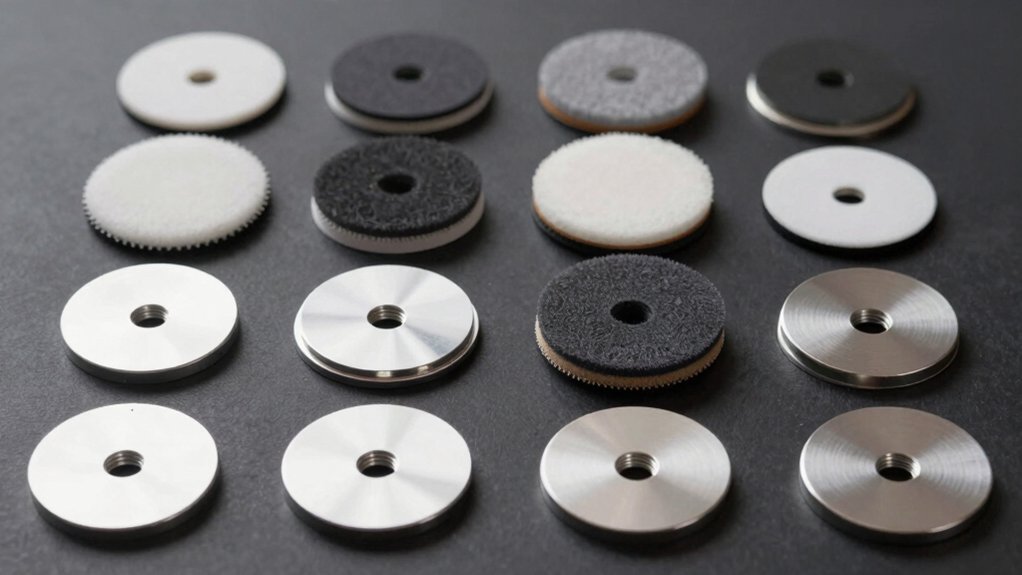
Choose a backing plate that matches your pad diameter and spindle thread so the pad sits flat, compresses evenly and won’t cave at the edge under torque. Verify hole-pattern alignment for perforated pads and dust extraction. Match hook-and-loop diameter and hook density to pad stiffness and cut level.
Use a flat plate for flat pads, stepped or contoured plates for dual-diameter pads, and perform a low-speed spin test. Keep going to learn specific size, thread and hook pairings.
Quick Overview
- Match pad diameter to backing plate diameter for even compression and maximum polishing area.
- Use a full-size plate for larger pads to avoid edge cave-in and loss of cut.
- Verify spindle thread size and hole-pattern alignment before mounting to prevent loosening or misalignment.
- Match hook-and-loop diameter, hook density, and plate profile to pad geometry for secure, flat seating.
- Maintain ≥90% pad-to-plate overlap. Clean surfaces, and torque-test at operating RPM to confirm retention.
Pad Diameter vs Backing Plate
How does backing plate size change what your pad actually does on the paint? You learn quickly: a matched backing plate gives even compression and maximizes polishing area. An undersized plate causes pad edges to cave; this reduces cut and risks an uneven finish. Choose backing plates and pads with pad safety features like recessed or back-cut attachment for reliable edge protection.
Consider that a 5″ plate works acceptably on 5.5″ pads but may underperform on 6.5″ pads. A full 6.5″ plate restores efficiency.
| Pad Diameter | Backing Plate | Effect |
|---|---|---|
| 5.5″ | 5″ | Standard compatibility, efficient |
| 6.5″ | 5″ | Edge cave-in, reduced area |
| 6.5″ | 6.5″ | Even compression, max efficiency |
Thread Size & Hole Pattern
Why does thread size and hole pattern matter when you’re mounting pads? You need correct thread size on the machine spindle to match the backing plate stud; a mismatch risks loosening or stripping during use. Hole pattern alignment secures pad centering and allows airflow or hook-and-loop engagement without distortion.
Select backing plate and pad diameter that share compatible hole layout and thread pitch so the assembly runs true at speed.
- Verify spindle thread size against backing plate specification before purchase.
- Match hole pattern positions when using perforated pads to maintain cooling and dust extraction.
- Choose backing plate diameter appropriate for pad diameter to avoid overhang and imbalance.
- Use torque specs for final mounting to prevent thread damage and ensure concentricity.
Pad Hook-And-Loop Compatibility
When you select pads, match the hook-and-loop diameter to the backing plate and confirm the plate profile so the pad seats flat. Check hook density and pattern; higher density gives firmer hold but can stress thin foam, while lower density eases removal and improves conformability.
Use proper attachment technique: aligned center, light pressure, and a quick spin at low speed to ensure safe, concentric bonding and consistent polishing performance.
Hook-And-Loop Basics
Hook-and-loop backing systems let you swap pads quickly while keeping alignment and grip consistent. However, you need to match pad diameter, backing-plate diameter, and hook pattern to get reliable hold and avoid wobble. You’ll learn hook and loop basics by checking pile density, hook height, and radial pattern. Dense, short hooks give uniform contact; taller hooks increase shear resistance but can misalign on small pads.
For pad attachment techniques, press concentrically from center outward. Then, rotate the backing plate slowly to seat hooks into the loop face. Inspect engagement by lifting at the edge. Proper fit resists peeling and lateral shift. Replace worn loop faces; degraded loops reduce holding force and increase vibration during polishing.
Pad Diameter Matching
How do you guarantee a pad won’t shift or peel under torque? You match pad diameter precisely to the backing plate contact area so hook-and-loop engagement remains full and concentric. Verify pad geometry: flat, sloped, or dual-diameter against the plate’s surface to prevent edge lift or eccentric loading.
Use pads sized to maintain at least 90% overlap with the plate’s loop field. Smaller pads concentrate stress and larger pads can extend beyond the plate, reducing retention. Consider coating compatibility: some pad adhesives and loop materials bond poorly to certain clearcoat residue or wax, so clean surfaces and select matching materials.
Finally, torque-test assemblies at operating rpm before starting work to confirm secure retention.
Backing Plate Profiles
You’ll ensure reliable pad retention by matching backing plate profile to pad hook-and-loop geometry and pad slope. Flat plates work best with flat-backed pads, while conical or beveled plates require corresponding sloped or dual-diameter pads to maintain full-contact engagement. You’ll inspect hook pattern, loop density, and peripheral chamfer to confirm full-surface load transfer and prevent edge peel.
Select plates whose radial contour mirrors pad slope so shear forces distribute evenly across the pad material chemistry; mismatched profiles concentrate torque at the edge and accelerate delamination. For dual-diameter pads, verify top-and-bottom diameters align with plate steps. Use measuring calipers and test rotations at low speed to validate secure seating before full-speed polishing.
Hook Density Effects
Because hook density determines how force and shear transfer across the pad interface, you should match plate hook patterns to pad loop structure to prevent edge peel and uneven wear. You’ll evaluate hook density relative to backing plate profiles: dense hook arrays give uniform load distribution on flatter plates, while sparse hooks concentrate attachments useful for flexible, contoured plates.
Choose higher hook density when using firmer pads or heavy-cut applications to minimize micro-slip. Use lower density with soft, thick finishing pads to preserve foam compliance. Inspect mating surfaces for full-contact engagement and avoid mixing incompatible densities that produce concentrated stress points. Proper pairing extends pad life, maintains consistent cutting action, and prevents premature separation during high-torque polishing.
Pad Attachment Techniques
Want consistent, secure pad mounting that won’t peel or wobble under load? You should match hook-and-loop density to pad backing patterns: denser hooks for firm dual-diameter or thicker 25–30mm pads, medium density for standard 125–150mm pads.
Inspect attachment surfaces for debris, replace worn backing plates, and align center holes to prevent imbalance. For pad maintenance, clean hooks and loops with a stiff brush and store pads flat after use to preserve nap and bonding.
When you change pad sizes, confirm backing plate diameter and dual-diameter labeling (e.g., 130/150mm) for proper contact area. For polish storage, allow pads to outgas before stacking and keep them in dust-free containers to avoid contamination.
Compatibility Troubleshooting
How do you quickly diagnose a hook-and-loop mismatch? Inspect the pad center: measure the hook diameter and loop offset, then verify concentricity against the backing plate. If wobble or slippage appears, check pile height and adhesive bond. Insufficient pile or degraded glue causes failures often mistaken for size issues.
Do not accept compatibility myths that blame pad diameter alone; tolerance, pile geometry, and chamfered edges matter. Test-fit using a low-speed spin before applying compound. Listen for chatter and monitor radial runout with a dial indicator if available. Replace pads showing compressed or uneven loops.
Document successful combinations to avoid backing plate myths and reduce trial-and-error. Proper measurement and a methodical test eliminate most hook-and-loop fit problems.
Frequently Asked Questions
Can Pad Thickness Affect Heat Buildup During Polishing?
Yes, pad thickness affects heat buildup. Thicker pads provide more cushioning and air insulation; you’ll see reduced heat transfer to the paint and slower heat buildup during heavy polishing. Thinner pads compress more, increasing friction and concentrating heat at the surface.
For aggressive cutting or prolonged runs, choose thicker or dual-layer pads to manage temperatures, reduce clearcoat stress, and maintain consistent cutting performance without overheating.
How Do Pad Edges Influence Swirl Removal Effectiveness?
Pad edges affect swirl removal by controlling contact, pressure distribution, and heat generation. You’ll get better swirl removal when sharper, flat edges maintain consistent cutting action across the surface. Tapered or beveled edges reduce aggressive contact, lowering cutting power but improving blending and reducing halo marks.
Choose edge profiles to match compound aggressiveness and paint hardness; you’ll balance removal rate with finish quality while minimizing edge-induced swirl patterns.
Are There Recommended Pad Care and Cleaning Intervals?
Yes: you should clean pads after every job and deep-clean weekly if you work daily. You’ll extend pad life by monitoring pad thickness, pad edges, and pad materials for degradation. Remove compound to prevent heat buildup and compromised swirl removal. Follow manufacturer performance guides and pad color coding.
For ceramic coatings, use dedicated pads and rinse immediately. Maintain documented cleaning intervals to optimize results and safety.
Do Pad Materials React Differently With Ceramic Coatings?
Yes, pad materials do react differently with ceramic coatings. You’ll find foam, microfiber, and wool pads each interact uniquely: foam disperses polish evenly, microfiber offers aggressive cutting with finer heat buildup, and wool removes defects fast but risks excessive removal.
Ceramic coatings demand careful pad selection to avoid burning or uneven removal. You’ll choose softer, low-aggression pads and control speed, pressure, and product compatibility for safe, consistent results.
Can Pad Color Indicate Manufacturer-Specific Performance?
Yes, pad color can indicate manufacturer-specific performance. You’ll find color coding maps to cut level, compound affinity, and intended use; however, standards vary by brand, so you must verify specs.
Also, consider pad thickness: thicker pads cushion pressure and alter heat buildup, changing cutting behavior. Use manufacturer datasheets and test spots to match pad color designations with real-world aggressiveness, finish quality, and compatibility with coatings.
Conclusion
You’ve seen how pad diameter, backing plate profile, thread size and hole pattern all have to match for secure, effective polishing. Check hook-and-loop compatibility and hook density to assure firm engagement without vibration.
When swapping pads, confirm diameter and backing plate contour. Then verify thread and hole alignment. If fitment issues persist, test alternate backing plates or adapter rings rather than forcing mismatched components. Proper matching preserves tool balance, pad life and finish quality.