Rinseless Wash Workflow Checklist
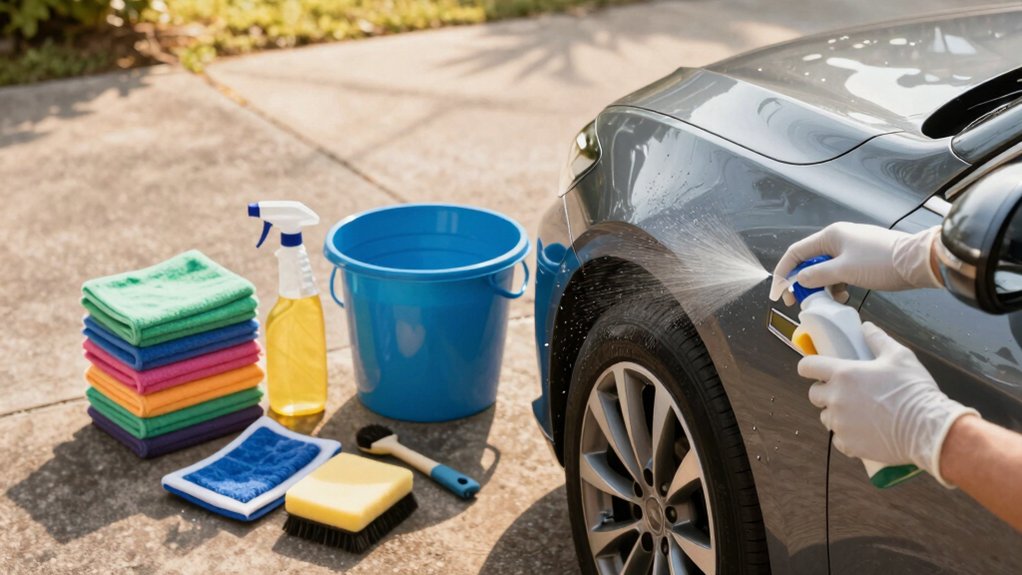
You’ll mix rinseless wash using exact dilutions (typically 1–2 gal water per 0.5–1 oz concentrate), warm filtered water, and calibrated tools. Then soak towels and label buckets. Work in 45–85°F (7–29°C), keep panels small, pre-spray and dwell 1–3 minutes, agitate quickly, and reapply if the surface dries.
Store concentrate and mix at 45–75°F; avoid freezing and use insulated storage if needed. Follow these controls and you’ll find detailed steps and troubleshooting next.
Quick Overview
- Mix concentrate precisely: follow exact dilution ratios, use calibrated tools, and pre-mix thoroughly before adding towels.
- Pre-spray and allow 1–3 minutes dwell; agitate quickly, and keep sections small to maintain lubrication.
- Operate between 45°F–85°F (7°C–29°C). Warm solution in cold and work in shade in heat to control evaporation.
- Monitor surface drying continuously. Reapply if tacky and rinse/dry promptly to avoid streaks and spotting.
- Store concentrate and mixed solution at 45°F–75°F (7°C–24°C); label buckets, and discard compromised or frozen stock.
Water-To-Solution Ratio Chart
Why does the exact dilution matter? You follow precise ratios to protect paint, avoid streaking, and conserve product. Minor variance isn’t catastrophic; however, you won’t treat this as an irrelevant topic or add unrelated detail.
| Application | Water | Product |
|---|---|---|
| Rinseless wash | 1–2 gal | 0.5–1 oz |
| Quick detailer | 1 gal | 8 oz |
| Clay lube | 1 gal | 2 oz |
Use distilled or filtered water, warm temps, and mix thoroughly before adding towels. Soak mitts to ensure encapsulation polymers form an ionic lubrication cloud. Don’t exceed recommendations; higher concentration wastes product and can streak. You’ll measure and test on a panel. Then, you can proceed confidently, balancing efficiency with surface safety.
Dilution Ratios & Contact Times
Because correct dilutions and contact times determine cleaning efficacy and paint safety, you’ll measure and mix precisely before you start each rinseless stage. You’ll prioritize dilution accuracy and follow contact time guidance to avoid over-concentration or excessive dwell that can harm trim or clearcoat. Use calibrated measuring tools and label mixed buckets.
- Mix: Follow product instructions (e.g., 1 capful/2–3 gal or 0.5 oz/gal) and verify with a measuring cup for repeatable dilution accuracy.
- Pre-spray: Apply solution, then allow advised dwell (typically 1–3 minutes) per contact time guidance.
- Agitate: Work section quickly within dwell window; reapply if surface begins to dry.
- Rinse/dry: Remove residues promptly and dry to prevent spotting and ensure safe finish.
Ambient Temperature Limits
You’ll operate best within the product’s specified temperature range to avoid reduced lubrication or accelerated evaporation. High heat increases surface drying speed and heat stress on polymers; cold raises freeze risk and can blunt product performance.
Adjust dilution, contact time, and working pace to compensate for ambient extremes.
Temperature Operating Range
What temperature should you work in to get consistent rinseless wash results? You should operate within defined temperature thresholds to maintain lubricant performance and dilution accuracy. Aim for an ambient range of about 45°F to 85°F (7°C to 29°C). Below 45°F, the solution thickens and polymers may not activate. Above 85°F, evaporation accelerates and spotting risk rises.
Follow mixing guidelines precisely at site temperature: measure concentrate per volume, adjust water temperature if needed, and pre-warm or cool your supply to stay inside range. Store mixed solution shaded and use within recommended dwell time.
If conditions sit near limits, shorten panel exposure, work smaller sections, and validate with a test panel to confirm lubrication and drying behavior before proceeding.
Heat Stress Effects
The ambient limits outlined above set the stage for how heat stress degrades rinseless wash performance: as temperatures climb above ~85°F (29°C), evaporation and solvent flash-off accelerate; polymers lose effective lubrication, and spotting and streaking risks rise sharply. You’ll face reduced dwell time for lubricants, faster microfiber drying, and increased risk of heat fatigue in both product and operator.
Work in shaded areas, shorten dwell and wipe cycles, and keep solution cooler to maintain polymer film and encapsulation. Use additional solution volume and more frequent re-soaking to counter rapid evaporation. Protect yourself with sunscreen protection and hydration. Heat fatigue impairs judgment and increases technique errors.
Monitor ambient temperature and postpone work when control measures can’t reliably prevent flash-off and spotting.
Cold Weather Concerns
In cold weather, you’ll face reduced product performance as low temperatures thicken solutions, slow polymer activation, and increase freeze and spotting risks on surfaces and in containers. Plan for a narrow ambient window, typically above ~40°F/4°C, where rinseless chemistries remain fluid, lubricants activate, and solvent evaporation stays low enough to preserve dwell time and wipeability. You should monitor ambient temperature and avoid working when readings approach the lower threshold.
Adjust your water to solution ratio modestly; warmer dilution can keep viscosity manageable, but don’t over-dilute past manufacturer limits. Warm your mixing water and store mixed solution insulated to maintain consistency during the job. Work quickly on small sections, use pre-wetted towels, and inspect frequently for spotting to prevent surface drying or surface residue in cold weather.
Product Freeze Risk
How cold is too cold for your rinseless concentrate? You need to know the product freeze point and recommended storage temperature to avoid separation, performance loss, or container breach. Check the label or tech sheet for freeze threshold; many concentrates begin to crystallize near 0°C (32°F) but some chemistries tolerate lower temperatures.
If ambient temps approach that threshold, move stock indoors or use insulated storage and avoid agitation until thawed. Never refreeze a thawed batch. Thermal cycling degrades surfactants and polymers.
Maintain storage temperature within the manufacturer’s specified range, typically 4–25°C (40–77°F), and log excursions. If you suspect a product freeze, quarantine the unit, inspect visually, and contact supplier before use.
Surface Drying Speed
Want to avoid streaks and water spots? You must control surface drying speed by managing ambient temperature limits and airflow. Work between 45–75°F (7–24°C) when possible. Below 45°F slows drying and reduces polymer activation; above 75°F accelerates evaporation and increases water interaction with paint, raising spotting risk.
In cooler temps, warm solution slightly and use plush towels to retain moisture longer. In warmer temps, work smaller sections and increase buffing cadence to remove residues before they dry. Minimize direct sun and cross-breezes that create uneven drying gradients. Monitor panel temperature with an infrared gun. If panels exceed ambient by more than 10°F, slow your pace or move to shade.
These controls keep finish consistent and minimize post-wash defects.
Safe Storage Temperatures
Store rinseless concentrate and prepared solution within a controlled range to preserve chemistry and performance: Keep ambient temperatures between 45–75°F (7–24°C). Avoid freezing (Prevent prolonged exposure above 85°F (29°C), which accelerates degradation and reduces lubricity.
You should label storage areas and monitor with a calibrated thermometer or data logger to ensure safe storage and rapid detection of temperature fluctuations. Rotate stock to use oldest material first and avoid long-term storage outside recommended range. If transport or workspace conditions risk extremes, insulate containers or use insulated cases with phase-change packs.
Document excursions and discard solutions that show separation, viscosity loss, or odor changes to protect results and finish.
Frequently Asked Questions
How Often Should I Change Microfiber Towels During a Wash?
You should change microfiber towels whenever they show visible dirt or drag. This typically occurs every 1–2 panels depending on soil. For towel maintenance, store used towels separately and launder after each wash.
Use microfiber rotation: dedicate one towel per panel. Swap to a fresh towel as soon as performance drops. Adjust wash frequency of towel changes for heavier contamination (wheels, lowers) and always replace any towel that risks scratching.
Can I Use Rinseless Wash on Matte or Satin Finishes?
Yes, you can use rinseless wash on matte finish safety and satin finish care if you’re careful. Use a low-lubricity, pH-neutral rinseless formula, soft high-pile towels, and very light pressure.
Test a small area first; avoid polishing or waxing with glossy products. Immediately replace towels when contaminated.
Dry and protect with products specified for matte/satin surfaces to preserve appearance and prevent unwanted gloss or marring.
What’s the Best Way to Remove Stubborn Bug Residue Safely?
You pre-soak bug spots with the rinseless solution or a dedicated bug remover, letting it dwell a couple minutes. That’s the best way to remove stubborn bug residue safely. Use soft microfiber, light pressure, and frequent rinseless-solution re-soaks to emulsify and encapsulate debris.
Safety considerations: Avoid harsh scrubbing, hot panels, or abrasive pads. Follow best practices by working top-down, using fresh towels per section, and drying immediately.
Is Rinseless Safe for Ceramic- or Polymer-Coated Paint?
Yes, rinseless is safe for ceramic coating and polymer coated paint when you use proper dilutions, soft microfiber, and low pressure. You’re not stripping the coating if you avoid harsh detergents, abrasive pads, or excessive agitation.
Monitor for durability concerns by checking hydrophobicity and contact angles over time. If repellency fades, reduce frequency or use coating-specific maintenance sprays. Follow manufacturer limits to preserve longevity.
How Do I Clean and Maintain the Grit Guard and Buckets?
Clean grit guard maintenance starts with removing it from the bucket, rinsing loose debris, and brushing with a soft nylon brush and mild detergent. For a reliable bucket cleaning routine, empty and rinse buckets after each use. Scrub inner walls and bottom; sanitize occasionally with dilute bleach or vinegar, then air-dry.
Reassemble only when components are fully dry. Inspect guards for cracks and replace if warped to ensure continued grit trapping.
Conclusion
You’ve got the control points you need to run a safe, effective rinseless wash. Match water-to-solution and dilution ratios to temperature; stick to contact times, and monitor ambient limits to avoid heat stress or freeze risk.
Adjust for faster surface drying in heat and protect product in cold. Store within specified safe temperatures and re-evaluate procedures when conditions change. Follow these parameters consistently to maintain cleaning performance and prevent equipment or product failure.