Rotary Polisher Vs Dual Action Polisher
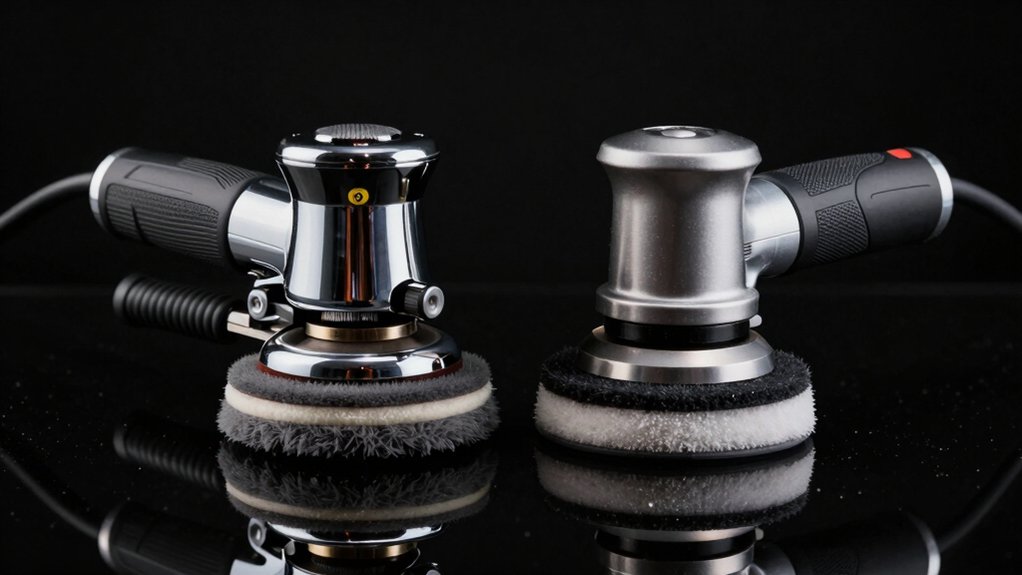
You’ll pick a rotary when you need maximum cut and direct speed control (600–3,400 RPM) for heavy correction. You will choose a dual‑action when you want safer, lower‑risk polishing with oscillation-driven micro‑shear (1,750–6,000 OPM, user settings ~3–6).
Match speeds: low for priming/finishing; mid for moderate correction; high only for aggressive cutting by experienced users. Check backing plate size, attachment type, and thread/arbor fit to avoid runout and heat buildup. More specifics follow.
Quick Overview
- Rotary polishers spin continuously, offering aggressive cutting power that is best for heavy defect removal by experienced users.
- Dual-action (DA) polishers combine rotation and oscillation, reducing heat and risk of clearcoat damage for safer use.
- Use lower DA speeds (1–3) for priming or finishing; use mid settings (3–4) for moderate correction. Rotary uses 600–900 for finishing.
- For heavy cutting, choose high rotary RPMs (2,500+ by pros) or DA at top OPM (6+) while monitoring heat and pad stall.
- Match pad diameter, attachment type, and backing-plate compatibility to the machine to prevent runout, vibration, and paint stress.
Pad Speed Comparison
How swift should you move the pad? You’ll align pad speed with task: rotary uses RPM (600–3,400) for aggressive cutting; DA uses OPM (1,750–6,000) with recommended user range 3–6. Control speed to protect pad life and ensure effective heat management. Higher RPM/OPM increases friction and thermal load.
Use lower settings for priming and finishing; mid settings for moderate correction; and high only for heavy cutting if you’re experienced. Monitor backing plate rotation: aim for 1–2 rotations per second baseline. Increase speed if rotation stalls. Use consistent, methodical passes and pauses to avoid overheating the pad or paint.
| Task | Rotary RPM | DA Speed |
|---|---|---|
| Priming/Finishing | 600–900 | 1–3 |
| Moderate Cut | 1,200–2,000 | 3–4 |
| Heavy Cut | 2,500+ (pro) | 6+ |
Oscillation Rate & G-Force
After you set pad speed and pass patterns, you’ll need to contemplate oscillation rate and the resulting G-force, because those two parameters determine the tool’s cutting and polishing behavior. You’ll assess oscillation rate as cycles per minute and calculate peripheral velocity. Higher oscillation rate increases micro-shear and can improve finish when matched to pad/compound.
Monitor g force since it quantifies centrifugal load on the pad and paint. Excessive g force raises heat and risk of clearcoat stress. Adjust duty: lower oscillation rate with aggressive compounds to avoid burn; higher rate with light polish for uniform gloss. Use measured increments and short passes to evaluate response. Record settings that deliver desired cut-to-finish balance without thermal buildup.
- Match oscillation rate to pad diameter and compound aggressiveness.
- Limit g force to prevent heat-induced paint damage.
- Test settings on a sacrificial area before panel-wide application.
Backing Plate Compatibility
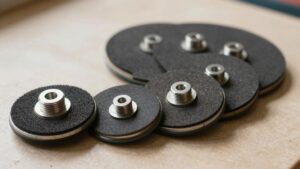
When you choose a backing plate, match plate size to pad diameter and consider how that size affects contact area and torque load. Check pad attachment (hook-and-loop vs. PSA), thread/arbor standards for your machine, and whether the plate material and durometer suit foam, wool, or microfiber.
Also, confirm compatibility with common adapters or spacers. This way, you can swap sizes or bridge mismatched threads without compromising balance.
Backing Plate Sizes
Which backing plate size you choose directly affects pad compatibility, torque transfer, and surface coverage. So match plate diameter to the pad and task. You’ll select common backing plate sizes (3″, 5″, 6″, 7″, 8″) based on work area and machine type; smaller plates give concentrated cutting, larger plates increase coverage but require more torque.
Consider adapter types for spindle thread and arbor fit. Ensure the plate’s center hole, thread pitch, or quick-change adapter matches your polisher. For rotary tools, prioritize stiffer, balanced plates to resist wobble under high RPM. For dual action machines, favor slightly flexible plates to accommodate orbital motion and reduce heat.
Measure plate diameter, check runout tolerance, and confirm secure mounting before operation.
Pad Attachment Types
How do you pick the right pad attachment for a given backing plate and polisher? Match pad diameter to plate size first. Then verify pad compatibility with the plate’s fastening system: hook-and-loop, adhesive, or clamp-style.
Inspect plate face for concentric alignment; misalignment causes vibration and uneven cut. Consider pad material durability relative to application: wool and heavy-cut foam wear differently than soft finishing foam. For rotary polishers, you’ll favor denser, heat-tolerant pads; for dual action units, choose resilient, low-heat-compression foams.
Check pad thickness versus spindle clearance to avoid contact with body panels. Test balance at low speed before full use. Maintain mating surfaces clean; contamination degrades adhesion and shortens pad life, reducing material durability and consistent performance.
Thread And Arbor Standards
Why does thread and arbor standardization matter for backing plate compatibility? You need consistent thread standards to ensure the backing plate secures to the polisher spindle without play or stripping. Check metric versus imperial pitches and diameters. Mismatched threads produce runout and vibration.
Equally important are arbor standards: register diameter, shoulder depth, and locating features determine concentricity and load transfer. When you match both thread standards and arbor standards, you maintain axial alignment, reduce wobble, and preserve bearing life.
Inspect manufacturer specifications for spindle thread, pitch, and arbor register tolerances before purchasing adapters or aftermarket plates. Use only certified adapters when converting between standards; torque to spec and verify runout with a dial indicator to confirm compatibility and safe operation.
Flexibility For Materials
After confirming thread and arbor compatibility, you should match backing plate material and design to the pads and substrates you’ll work on. Choose stiffer plates for hard-cut foams and older, harder clear coats when paint age indicates cured, dense layers; they transmit force efficiently.
Use compliant, softer plates for delicate soft pads and newer paint where paint age is low or unknown to reduce risk of heat and edge damage. Match plate diameter and flex pattern to pad profile so contact is even across contours.
Inspect for secure hook-and-loop or center-lock fitment and consistent concentricity. Measure effective material hardness and consider pad compression under load to predict cut and finish. This methodical matching maximizes correction control while minimizing substrate risk.
Adapter And Spacer Use
Adapters and spacers let you tailor backing plate fitment and offset to match pad diameter, arbor type, and surface geometry. So confirm thread size and center-lock standards before mounting. You’ll verify adapter compatibility by matching arbor thread pitch and male/female interface; use manufacturer charts or calipers to confirm dimensions.
For dual action and rotary units, ensure the adapter maintains concentricity within 0.2 mm to avoid vibration and uneven pad wear. Spacer usage adjusts working distance and reduces interference on curved panels. Pick rigid, heat-resistant spacers and avoid stacked thin spacers that compress under load. Torque adapters to specified values; then perform a static balance check.
Replace damaged adapters or spacers. Compromised components degrade cut control and increase risk of paint damage.
Frequently Asked Questions
Can a Beginner Safely Use a Rotary Polisher on My Daily Driver?
You shouldn’t; beginner safety favors a dual action tool. You can use a rotary only if you master proper technique first: control speed, keep constant motion, use light pressure, and test on inconspicuous panels.
Practice on scrap panels, monitor heat, and stop frequently to inspect for holograms or burns. If you lack experience, stick with dual action for daily driver maintenance until you develop the skills and confidence to handle a rotary.
Which Polisher Is Better for Removing Deep Scratches and Heavy Oxidation?
Rotary polishers are better for removing deep scratches and heavy oxidation. You’ll apply higher continuous torque and concentrated heat to cut through defects faster, using aggressive pads and compound in controlled passes. You must monitor temperature and use steady pressure. Additionally, you need to master edge technique to avoid holograms or burn-through.
Dual action can’t match aggressive cut for severe damage; therefore, reserve it for light to moderate correction and finishing.
Do Dual Action Polishers Reduce the Risk of Burning Thin Clear Coats?
Yes, dual action polishers reduce the risk of burning thin clear coats because their orbiting motion lowers friction and heat buildup. You’ll apply controlled pressure, use slower passes, and avoid aggressive compounds that simulate wet sanding heat.
For final protection, follow correction with polymer protection to seal and stabilize the surface. When tackling heavy defects, reserve rotary tools for experienced users to prevent clear coat damage.
Are Cordless Dual Action Polishers Powerful Enough for Full-Car Correction?
Yes, cordless dual action polishers can be powerful enough for full-car correction if you match torque, polish pad selection, and technique to the task. You’ll need high-voltage batteries and spare packs to offset battery life tradeoffs.
Work methodically: start with less aggressive pads, increase cut only where needed, monitor pad and motor heat, and swap batteries before power sag affects consistency. They’re viable for pros and experienced DIYers.
How Does Each Polisher Affect Working Time and Heat Buildup on Paint?
You’ll find rotaries shorten working time but raise heat buildup risk; this increases chances of burning clearcoat. You must manage heat via speed control, light passes, and frequent breaks.
Dual action extends working time and improves heat management; this reduces burn risk and swirl marks. You can work longer per panel with lower speed and overlap.
In both cases, monitor surface temperature, use thin pads, and keep moving to prevent damage.
Conclusion
You’ve seen how pad speed, oscillation rate, g-force, backing plate fit, pad attachment, thread/arbor standards, material flexibility, and adapter use differ between rotary and dual-action polishers.
Choose the tool that matches your process: rotary for high-speed cutting with correct technique and matching plates; DA for lower-risk finishing, varied materials, and simpler plate compatibility.
Match pad size, thread/arbor, and adapter specs precisely to avoid vibration, heat, or mechanical failure during operation.