Rubber and Vinyl Care Compatibility Reference
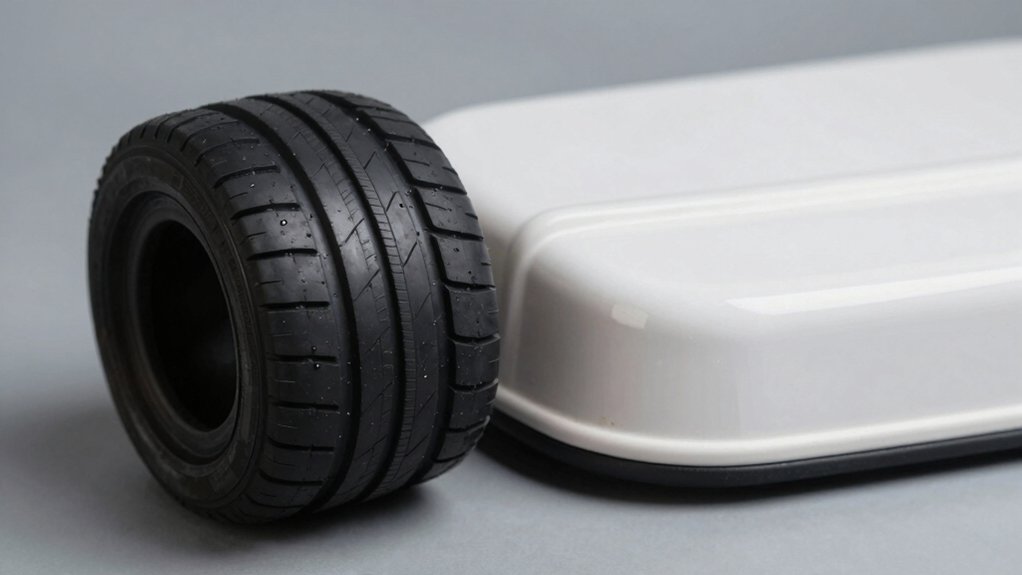
You should match durometer, thickness, material and temperature to avoid swelling, cracking or extrusion. Softer (40–50A) seals conform and resist impact; mid (60–80A) balance sealing and abrasion. Harder parts resist extrusion but may harden in cold. Choose EPDM for weather/water, NBR for oils, FKM for fuels; verify compatibility at service temperature because heat accelerates swelling and aging.
Test mass change and tensile retention for long exposures. Continue for more specifics.
Quick Overview
- Match cleaner and conditioner chemistries to material: polar solvents for vinyl; avoid nonpolar oils on rubber without compatibility data.
- Check durometer: softer rubbers (lower Shore A) swell and deform more from solvents than harder compounds.
- For oils, fuels, or solvents choose tested NBR or FKM grades and validated durometer for temperature and contact duration.
- Avoid strong solvents, ketones, and aromatic hydrocarbons on vinyl and most elastomers; use mild detergents or manufacturer-approved products.
- Validate with short-term soak and tensile/mass tests at service temperature. Monitor aging, swelling, and visual degradation.
Durometer, Thickness, Temperature Chart
Why does durometer matter when you select rubber or vinyl components? You balance surface hardness against flexibility and temperature tolerance to meet pressure, abrasion, and sealing needs. Use durometer to predict extrusion risk, sealing efficacy, and wear life: softer compounds seal better; harder ones resist abrasion.
| Durometer (Shore A) | Typical Use | Temperature Tolerance |
|---|---|---|
| 40A | Flexible pads, impact surfaces | Low-end cryo to moderate heat |
| 60A | General seals, gaskets | Broad commercial range |
| 80A | Heavy machinery, vibration | High-temperature service |
Match material durometer and thickness to application: thinner, harder parts resist extrusion but need higher surface hardness. Thicker, softer parts improve conformability yet limit max temperature performance.
Shore a Quick Checklist
How hard should your rubber or vinyl be for the job? Use this Shore quick checklist to match durometer guidance with function and temperature range. Decide by load, sealing needs, and expected thermal exposure.
For static seals, choose 60–90A for abrasion resistance; lower Shore for cushioning and impact absorption.
For dynamic seals, pick 40–70A to balance flexibility and extrusion resistance; confirm temperature range limits for compound aging.
For weather or ozone exposure, prefer softer EPDM or VMQ variants at relevant durometers; verify cold-flex below expected low temps.
For oil or fuel contact, select harder FKM/NBR grades with tested durometer and confirmed temperature range. Always validate with application-specific wear and chemical data.
Follow measured durometer guidance; test in service conditions.
Chemical Compatibility Table
Use the table to compare how each material interacts with common chemicals, focusing on solvent resistance ratings and observed swelling or softening. Pay attention to temperature effects. Note that elevated heat often accelerates long-term degradation and shifts ratings toward greater incompatibility.
Cross-reference specific rubbers and vinyl with empirical A–U ratings before selecting cleaners or solvents.
Material Interaction Overview
When you consult a chemical compatibility table, you get a concise map showing which rubbers and vinyls resist, tolerate, or fail with specific chemicals under defined conditions. You’ll interpret ratings against durability metrics and environmental aging to predict service life: an A rating implies minimal property loss, B signals measurable softening or swelling, C indicates compromised functionality, and U means failure risk.
Use the table to match material families—NBR for petroleum, EPDM for aqueous and ozone exposure, FKM for fuels—against operational exposures and temperature boundaries. Cross-reference contact duration, concentration, and mechanical stress. Short-term contact can differ from continuous immersion. Apply conservative selection when data are “?” or when aging factors accelerate degradation.
Solvent Resistance Ratings
Why does solvent resistance vary so much between elastomers and vinyls? You judge solvent compatibility by chemical class, polymer polarity, crosslink density, and additives. Use a chemical compatibility table to compare A–U ratings across materials; correlate those ratings with durometer thickness because harder, thicker parts often resist penetration longer.
Review specific examples: NBR shows A against petroleum (below 250°F); NR and SBR are unsuitable for many fuels. Vinyl performs well with polar solvents like rubbing alcohol but poorly with nonpolar small molecules. When you consult data, note that a temperature chart complements the table by indicating when rated performance may shift.
Don’t assume room-temperature A ratings hold at elevated service conditions. Test critical combinations before deployment.
Temperature Effects Overview
How does temperature change the chemical compatibility ratings you rely on? Temperature dependence alters reaction rates, diffusion, and sorption in rubber and vinyl; this shifts ratings from A toward B/C as heat increases. You should treat compatibility tables as baseline values valid at specified temperatures. Elevate caution when operating above those conditions.
Thermal aging compounds effects: prolonged exposure accelerates polymer chain scission, crosslink changes, and embrittlement. This reduces chemical resistance even if short-term tests appear favorable. Assess compatibility by combining chemical classification with expected service temperature and duration. Prioritize materials with proven high-temperature performance (e.g., FKM, silicone for heat resistance).
Verify with application-specific aging studies or vendor data rather than relying solely on room-temperature charts.
Swelling And Softening
Ever wondered why a rubber part that resists a solvent at room temperature suddenly softens in service? You should link that change to swelling causes and softening mechanisms mapped in compatibility tables. Solvent uptake diffuses into the polymer network, increasing free volume and reducing intermolecular forces; plasticization follows as small molecules act like internal lubricants.
Temperature, solvent polarity, and elastomer chemistry control rates: polar solvents attack polar rubbers, nonpolar solvents swell nonpolar elastomers. Swelling causes dimensional change, stress relaxation, and loss of modulus. Softening mechanisms reduce load-bearing capacity and accelerate deformation under strain.
Use the table to predict immediate compatibility and test at service temperature and concentration to quantify swelling and softening risks before deployment.
Long-Term Degradation
Swelling and softening set the stage for long-term chemical degradation by altering a material’s network and accelerating chemical attack. You should consequently read compatibility tables with an eye toward cumulative effects over time. You’ll use table ratings to predict long-term degradation trends: repeated exposure to A-rated polar solvents can still produce dimensional change. Meanwhile, B–C interactions often progress to embrittlement, cracking, or tackiness.
Focus on cumulative dose, temperature, and frequency; these multiply effects shown in single-exposure charts. For vinyl and rubbers like NBR, EPDM, and FKM, note chemicals that induce swelling and softening first. Then track property loss (tensile, elongation, hardness). Use compatibility tables as a conservative guide and plan material changes before functional failure occurs.
Testing And Measurement
When you read a chemical compatibility table, ask which tests produced the ratings and under what conditions. Test method, exposure time, temperature, and specimen preparation all drive the results. You’ll verify whether the table used standardized tests (ASTM, ISO) or proprietary protocols; you’ll also check whether exposures were static immersion, dynamic flex, or vapor contact.
Record mass change, tensile property retention, and visual defects to quantify swelling prevention and degradation. Note temperature cycling ranges and dwell times: thermal expansion and contraction reveal microcracking and interface failure unseen at single temperatures. Check specimen geometry, cure state, and media concentration; small differences shift ratings from A to C.
Use short-term screening plus accelerated aging to predict real-world performance with measured confidence.
Frequently Asked Questions
How Do I Store Rubber and Vinyl Long-Term to Prevent Degradation?
Keep items cool, dry and dark: Store between 15–25°C for long term storage, avoiding heat spikes. Use breathable, acid-free packaging and separate rubber from vinyl to prevent color transfer and dye bleed.
Don’t stack heavy loads; support shapes to avoid distortion. Keep away from ozone sources, fuels, solvents and sunlight.
Rotate inventory and inspect periodically. Replace items showing tackiness, cracking or swelling to prevent failure.
Can Colourants or Dyes Bleed From Vinyl Onto Rubber Items?
Yes, colourants bleeding from vinyl can cause dye transfer onto rubber, especially when vinyl is new, damp, or exposed to heat or solvents. You should test with a hidden patch and avoid prolonged contact between differently colored items.
Store dry, cool, and separated by inert barriers (paper or cloth). If transfer occurs, clean promptly with rubbing alcohol on compatible rubber; test first to minimize staining and chemical interaction.
Are There Safe Household Cleaners to Disinfect Rubber and Vinyl?
Yes, you can use safe cleaners like diluted rubbing alcohol (70% isopropyl), mild soap with water, or diluted bleach solutions on many rubber and vinyl items. However, check disinfectants compatibility first. You’ll want to spot-test for color bleeding or material degradation. Avoid strong solvents on vinyl and natural rubber, and limit prolonged exposure.
Follow manufacturer guidance; rinse thoroughly after disinfection. Dry items to prevent swelling or mildew.
How Do UV Additives Affect Vinyl Longevity Outdoors?
UV additives considerably slow outdoor aging of vinyl by absorbing or dissipating UV energy. You will see reduced color fading, embrittlement, and loss of tensile properties. You will want stabilizers tailored to the resin and exposure: hindered amine light stabilizers (HALS) plus UV absorbers are common. They will prolong service life; however, performance depends on additive concentration, dispersion, and environmental stressors.
Testing outdoor aging gives the best durability prediction.
Can Rubber and Vinyl Be Recycled or Repurposed Easily?
Yes, but it’s complex. You can access recycling pathways for some rubbers (NBR, EPDM, FKM) and vinyl (PVC) through mechanical grinding, devulcanization, or chemical recycling; yet repurposing challenges limit scale. Contamination, mixed polymers, additives, and crosslinking raise costs and lower material quality.
You should sort, clean, and test materials. Design for disassembly and use compatibilizers or downcycling into mats, flooring, or molded parts to improve viability.
Conclusion
You’ve seen how durometer, thickness, and temperature jointly affect rubber and vinyl performance, and how Shore A values guide quick decisions. Use the chemical compatibility and solvent resistance tables to predict swelling, softening, and long-term degradation.
Account for material interactions and test results before specifying parts or cleaners. When in doubt, run application-specific tests under expected temperatures and exposures to confirm compatibility and prevent premature failure.